
Teeth whitening is a desirable procedure for many people as it can dramatically change the appearance of their smile in just one visit to a dental office. But is teeth whitening safe for everyone? In this article, we discuss teeth whitening for patients with thin enamel.
Teeth Whitening for Patients with Thin Enamel
Thin enamel can be caused by such factors as genetics, acid erosion, aggressive brushing, bruxism (involuntary teeth grinding), and aging. When your tooth enamel is thin, you might experience increased sensitivity to hot and cold foods and drinks. Additionally, the dentin beneath can become more visible, making teeth appear darker or yellowish.
Teeth with thin enamel can be damaged by whitening if the procedure is not done professionally or the whitening solution is too strong. The reason for this is that the whitening agent (typically hydrogen peroxide—essentially a bleach) temporarily makes the enamel more porous, allowing it to penetrate deeper and destroy the dark pigment.
A cosmetic dentist evaluates the condition of your teeth enamel before the whitening and can adjust the strength of the solution to tailor the procedure to your needs and ensure its safety. However, when the risk of enamel damage is too high, your doctor might advise you to postpone the procedure until the health of your enamel improves or recommend alternative cosmetic solutions.
Types of Professional Teeth Whitening for Patients with Thin Enamel
A reputable cosmetic dentist will always conduct a comprehensive oral health examination before a teeth whitening procedure to determine the risks and the type and strength of the solution that can be safely used on your teeth. Typically, cosmetic dentists offer one of the following types of whitening procedures:
In-office Teeth Whitening
In-office teeth whitening uses controlled concentrations of whitening agents and protective measures to minimize sensitivity and avoid enamel damage.
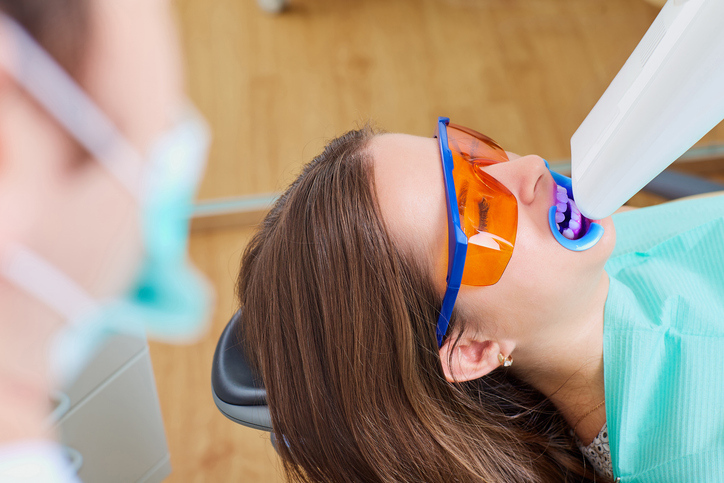
In-office teeth whitening can be done with gel application trays or dispensed from a syringe or an applicator tip. In addition, lasers, LED curing lights, or plasma lights can be used to aid the procedure for optimal results.
At-home Whitening Kits
At-home whitening kits provided by your dentist (do not confuse them with over-the-counter kits) are usually custom-made to address your oral health needs. Such kits are designed to gradually expose your teeth to a whitening solution, allowing for lower-strength gels and minimized discomfort.
At-home whitening solutions typically come in the form of trays, which are applied to the teeth for 30 minutes to a couple of hours a day for several weeks.
Is Over-the-counter Whitening Safe for Patients with Thin Enamel?
Over-the-counter whitening solutions are not safe for people with thin enamel. In fact, such products pose a risk of permanent enamel damage because they are not tailored to your personal oral health needs but are designed for an average customer with healthy teeth, and you cannot control the strength of an over-the-counter whitening solution.
Even people with perfectly healthy teeth are not recommended to use over-the-counter whitening solutions due to the risks of oral health damage. You should always consult your dentist before undergoing a whitening procedure and, if possible, opt for a professional whitening.
Similarly, never use abrasive whitening toothpaste, especially if it contains soda or charcoal, or home-made whitening solutions with baking soda, hydrogen peroxide mouth rinse, lemon acid, or activated charcoal.
Sign up for a Safe Teeth Whitening at Baseline Dental
If you are considering a teeth whitening procedure, do not hesitate to make an appointment with an experienced cosmetic dentist at Baseline Dental. Our specialists will carefully evaluate the health of your teeth and enamel to determine which procedure will best suit your needs and goals. We are looking forward to your visit.